Main

Science Archives

April 11, 2008

Cultured meat becoming a reality, still grossing people out

fake meat

Today the Times' environmental blog Dot Earth has a piece about manufactured meat, which is grown in a lab through animal cell cultures instead of as actual animals.

The idea of lab meat has been freaking people out for a few years now as scientists have been figuring out how to culture meat using stem cells. Advocates point out that cultured meat doesn't require killing animals, doesn't cause the environmental damage of raising livestock, produces no waste bone, fat, or other tissue, and is essentially no different from making yogurt or wine by processing natural raw ingredients. And sausages and chicken nuggets are already heavily processed and not really visually recognizable as meat the way a steak or a chicken wing is.

But people still think eating meat grown in a lab is creepy, even if they're cool with eating actual animal meat that's been processed into a sausage or chicken nugget. You also can't grow a pork chop or a wing in a lab.

The Times has been covering this technology for a while, and featured it in the 2005 Year In Ideas issue. The best part of that article is a photo of mouse stem cells, labeled with the caption, "Tube steak?" Dick joke in the Times!

I'm probably going to stick with Boca's delicious Chick'n Nuggets and breakfast links, which are pretty much indistinguishable from genuine processed meat already.

November 12, 2007

Georgia prays for rain

Dog River Reservoir runs dry

Georgia and much of the southeast have been in a serious drought for months now. One town in Tennessee ran out of water a couple of weeks ago, and the Dog River Reservoir in sububuran Atlanta (pictured above) is nearly dry. Bans have been instituted on "secretive late-night lawn watering" with violators getting their water supply shut off.

So tomorrow, Georgia governor Sonny Perdue is going to pray for rain, along with state legislators and religious leaders. Some residents think this makes total sense. As Rocky Twyman, the organizer of a recent rain-dedicated gospel concert, said:

We need to call on God, because what we're doing isn't working. We think that instead of all this fussing and fighting, Gov. Perdue and all these others would come together and pray.

Uh huh. I guess by "fussing and fighting" he means "conserving water". Given that greater Atlanta has become synonymous with "urban sprawl hell", and the fact that there are no lakes that aren't man-made in the entire state of Georgia, then yes, it's true: what they're doing isn't working.

Not everyone likes that the state government is turning to prayer to address the problem. The Atlanta Freethought Society is staging a protest. "The governor can pray when he wants to," said Ed Buckner, who is organizing the protest. "What he can't do is lead prayers in the name of the people of Georgia."

But the last time the governor prayed for rain, it worked! Kind of. In 1986, then-governor Joe Frank Harris sent out a proclamation asking Georgians to pray for rain. A few days later began "several weeks of almost daily rains," he claims, though the Atlanta Journal-Constitution reports that they actually started getting some rain a few days before the magical state-wide prayer intervention.

February 2, 2007

AP headlines

Some unintentional irony in the headlines of today's AP top stories:

AP Top headlines

This is the first year the groundhog hasn't seen his shadow since 1999.

[tx bar]

November 21, 2006

Free-for-all on science and religion

A recent conference at the Salk Institute in La Jolla brought together internationally famous scientists to talk about how to advance scientific thought in a world increasingly full of religious nutcases. But proving that Nobel Prize winners might not have the greatest social skills, it descended, after a day or two, into what one scientist called a "den of vipers"--looks like even the science side of this increasingly messy and circular debate can't agree on what to do.

The Times covered the conference, and included tons of snippy little comments and smackdowns. Here are a few of the better ones:

Steven Weinberg, a Nobel laureate in physics: “Anything that we scientists can do to weaken the hold of religion should be done and may in the end be our greatest contribution to civilization.” Whew.

Francisco J. Ayala, evolutionary biologist at UC Irvine: “There are six billion people in the world. If we think that we are going to persuade them to live a rational life based on scientific knowledge, we are not only dreaming — it is like believing in the fairy godmother.” Snap!

Champion blood-vessel burster Richard Dawkins, evolutionary biologist and author of The God Delusion: “I am utterly fed up with the respect that we — all of us, including the secular among us — are brainwashed into bestowing on religion. Children are systematically taught that there is a higher kind of knowledge which comes from faith, which comes from revelation, which comes from scripture, which comes from tradition, and that it is the equal if not the superior of knowledge that comes from real evidence.” Stamp those little feet, Dawkins!

Then Melvin Konner, an anthropologist at Emory, called Richard Dawkins “a remarkably apt mirror image of the extremists on the other side,” and said views like his “generate more fear and hatred of science.” Is he calling Dawkins a snake-handler?

Lawrence M. Krauss, a physicist at Case Western Reserve University: “I think we need to respect people’s philosophical notions unless those notions are wrong. Science does not make it impossible to believe in God. We should recognize that fact and live with it and stop being so pompous about it.” Meow!

But Neil deGrasse Tyson, director of NYC's own Hayden Planetarium, may have been the only one there to take a communications class as an undergrad. He advised, "Persuasion isn’t always 'Here are the facts — you’re an idiot or you're not.'"

Sounds like they have their marketing jingle.

February 13, 2006

Science and Technology Awards

George Lucas wins National Medal in Technology

Today Bush awarded 15 National Medals of Science and Technology to some of the most revolutionary, innovative thinkers in our country. And George Lucas.

Bush said, "From Thomas Edison's light bulb to Robert Ledley's CAT scan machine, most of America's revolutionary inventions began with men and women with a vision to see beyond what is and the desire to pursue what might be," which in George Lucas' case apparently means seeing beyond your universally loved trilogy of movies and pursuing what might be the lamest, most disappointing climax possible to the cinematic mythology that defined our young generation.

Recipients contributed important work in genetics, found whole new fields of mathematics, created GPS technology, developed the semiconductors we use in pretty much all our consumer electronics, and greatly improved detection of HIV and Hepatitis C. And seriously thought that Hayden Christensen was a good choice to embody the eternal struggle between good and evil.

Way to go, George Lucas! At least you also made some decent video games.

June 23, 2005

Plovers: 1, Hamptonites: 0

piping plover

Swanky Fourth of July parties at the Hamptons this year will have to go without fireworks displays, due to the return of an endangered species of bird, the piping plover, to the area. The federal government will fine any town that disturbs the nests of the birds, and this year, they're all over East Hampton. Government guidelines about setting off fireworks in areas where plovers nest are here.

Well! Though many of them may be environmentalists by the checkbook, socialites of East Hampton are not used to having their parties disrupted by no goddamn birds. The author of the article spoke with Jerry Della Femina, an advertising executive and restaurateur, and his wife, Judy Licht, a photographer and writer, who have played host to a Fourth of July celebration for at least 10 summers. She writes, "The gregarious Mr. Della Femina was first at an uncharacteristic loss for words when a reporter told him the display had been canceled this year. He quickly recovered.

'I just sent out invitations to about 500 people,' said Mr. Della Femina, who is often an outspoken critic of village government. 'That's insane. They must be out of their minds. I'm flabbergasted.'"

He says he still plans to have his traditional party. "We'll still have it," he said, "but we'll be serving barbecued piping plover. I hear it tastes like chicken."

Just wait till next year, pal, when your swimming pool and croquet court are overrun with swarming pissed off piping plovers who crap all over your sun patio and build nests in your sculptured topiary.

May 11, 2005

An insightful psychological test

Some researchers at the University of Missouri recently investigated how alcohol would influence the sexual stimulation of a bunch of undergraduate boys. Because these are very clever researchers, they pretty much assumed that many college guys would tend to rate the attractiveness of college girls higher if they had a few drinks first. But what they decided to test in this study is if brief exposure to masked words that are related to alcohol would have a similar effect. Basically, could they get some guys to respond to women the way they do when they're drunk just by showing them words like "beer"? Even if what they were shown was actually "xdbeerilq"?

They sure could! [abstract of the article here] The researchers found that if men had previously indicated that they get a little extra romantic feeling when they've been drinking, they rate women as being more attractive than do men who claim no such lusty effects when they drink, after both sets of men are flashed with words like "rwqdrunkmi".

What does this mean? The researchers conclude only that "the effects of alcohol expectancies on behavior are remarkably subtle and far-reaching." Just thinking about alcohol, even subconsciously, seems to produce the aphrodisiac effects we expect to experience when we drink. What I wonder is if guys who self-report that they become more interested in women after they drink are just generally more girl-crazy than guys who don't, um... OK, I'm trying to avoid the term "beer-goggles" here, but it looks like I can't get around it.

So now I'd like to conduct a little test.

1) Please answer the following questions:

Do you tend to get that rogueish spark in your eye after you've had a few drinks?

Have you ever made out with someone in the bathroom of a bar that you would probably not even notice on the subway?

2) Now look at this:

rwhiskeyipl
eqwalcoholfc
rfgohmygodimsodrunkmkt
azqwaithowdidigethomepnyy
stgispringbreakwoooooooobngdr
fghrdudeletsdosomekegstandspkh

3) Now look at this picture and rate the attractiveness of the women you see.

Yow! Pretty foxy right? No? Well, try doing a few shots of Wild Turkey, then repeat the test.

October 13, 2004

Just put it on my chip, Bartender!

verichip

At last, at last! Today the FDA finally approved the implantable microchip VeriChip™ for medical use. VeriChip™ is already in use to keep your pets from getting lost (and similar radio frequency identification, or RFID, tags are used in everything from library books and ID badges), but the approval of the chip for medical information will open up a whole new world of possibilities. With VeriChip™, you will never again have to call your mom to ask your blood type. Instead, your doctor can simply scan the chip in your bicep, and the chip's serial number will link to all that information you can never remember.

"Whatever," I hear you say. "Why should I get The Chip for something so boring?" But wait! What if, like in the Mexico attorney general's office, you could implant The Chip in your employees to give them security clearance? What if, like Spanish clubgoers, you could use your chip to buy drinks at the bar? (This strikes me as both the most brilliant idea ever and also the most dangerous, kind of like using your credit card in the slot machines.) And the best part? Your VeriChip™ will last 20 years!

It's curious that VeriChip™'s parent company Applied Digital Solutions touts itself as specializing in "security". Security for who? I'm constantly amazed at how consumers in our surveillance culture giddily give up their personal information without any comprehension of who is using it, and how.

Here is one BBC correspondent's story of his night on the town with his chip.

Wikipedia on RFID tags and the controversy on their usage.

Or pre-register for your personal VeriChip™ here.

September 29, 2004

NOVA's Origins series

origins

The new season of PBS' NOVA premiered last night with the first part of a miniseries called Origins, which examines the beginnings of our planet, life, the universe, and everything. Part 1 aired last night, and addressed the creation of planet Earth. The show operates on two levels: one offers complex theories and genuine scientific inquiry into topics like the formation of amino acids and peptides, while the other involves a lot of hokey digital graphics of planets colliding and gigantic resulting explosions that get replayed over and over again. Perhaps the study of space and planet formation seems just a little bit childish and dorky because the last time anyone I knew admitted they were into this stuff was in 4th grade, and those kids weren't exactly in hot demand during kickball team selection. The Mr. Wizard's World-esque fake lab sets didn't much impress the New York Times either; their review notes, "Corny gags are meant as breaks in the solemnity, but might also work against the show's popularizing goal. Mature viewers might receive a this-is-kids'-stuff signal. Cool-conscious youths might conclude, 'If I watch this, then I am a geek.'"

Of course, there are many people out there who are proud to be personally interested in planets and outer space explosions and dinosaurs. Even David Bowie asked "Is there life on Mars?" and no one has called him Bugface for a good many years. In a person-on-the-street interview section, New York's own Naked Cowboy sternly insists that it would be "ridiculous" to think that we are the only intelligent life in the universe. Many of the scientists featured on Origins have fascinating jobs, as well as obvious disregard for their social status and popularity. A Canadian scientist rides around by himself on a dog sled every year to track the ever-moving magnetic North Pole, and seriously refers to making speculations about the future location of it as "dangerous."

However, I couldn't help but notice that I had already learned most of the key concepts in Origins by watching the 2003 movie The Core, which operated as a vehicle for many once-respected actors to degrade their careers and damage their credibility. The earth's molten core is what maintains our gravitational pull? Yeah, no kidding, it also keeps pigeons from freaking out and attacking everyone in Trafalgar Square! This gravitational pull also acts as a force-field that protects us from the solar wind? If you saw The Core, you knew that one too! It also once protected Aaron Eckhart from starring in crappy sci-fi movies! And Suspect Zero!

Part 2 airs tonight, and covers how life on earth began.

May 3, 2004

U.S. Losing its Top Position in Sciences +

A post from our friend Jim:

Here's an interesting juxtaposition of articles from recent editions of the New York Times. Today, we learn that the United States is producing fewer PhDs in the sciences than is used to, that we account for a smaller share of world patents and Nobel Prizes than we used to, and that fewer foreign graduate students are choosing to come here. Some of this I think is overrated: if Asian countries produce more PhDs, and European universities encourage their faculty to publish rather than pontificate, it's a good thing for the world, and says nothing about changes in America. But some of this is very bad news: fewer foreigners are coming partially because visa restrictions are getting tougher for foreign students, and green cards are harder to get. Importing the best and brightest from India and China might be bad for India and China, but it's a windfall for us. Why is it so great?

Why, for the reasons laid out in this article. While Singaporeans and Germans are out studying physics and biochemistry, publishing journal articles and starting companies, American high school students are going to Creationist theme parks. Creationism sure is an appealing philosophy. Why bother studying hard classes like biochemistry and genetics when your church says it's all lies? This sort of foolishness didn't matter so much when it was a bunch of bumpkins in Tennessee who weren't going to amount to anything more than textile workers anyway, but now that those textile jobs have moved to other countries, it would be nice to get some warm bodies into science programs. What a shame the only thing that develops slower than the Southern economy is the Southern worldview. -Jim

In other troubling education news, CUNY has included an initiative in its four-year plan to recruit and retain more black men in its colleges. It looks like men in general are seriously in trouble in New York public higher education, representing only 38% of all CUNY students. The largest race group at CUNY schools is black (31%), so it makes sense to target black men specifically to raise enrollments of all men. Interestingly, schools within CUNY that have the highest majorities of black students also have the largest disproportion of female students: Medgar Evers College's students are 92% black and 78% female. Maybe the new breed of affirmative action programs need to focus not only on class, but also on gender. -Amy

March 10, 2004

New eggs?

Natalie Angier has a small piece in the Times about a new study out today that says that we might be wrong about the way females produce eggs. Science has always held that even before female mammals are born, they already have all their egg cells sitting in their tiny little ovaries, waiting to ripen, and that no new eggs are made during the life of the animal. Now it looks like adult female mice have stem cells in their ovaries, which suggests that the ovaries might be "busy creating new little egglets" during the life of the mouse. If this is right, it would eventually change the way we think about fertility, menopause, and control over when to have children. Here's the article in Nature.

So pretty much, if you're thinking of donating your eggs and getting compensated $7,000, get it while the gettin's good.

February 2, 2004

Face Off

LA Times has an interesting piece on face transplants, which a group of doctors at the University of Louisville in Kentucky are hoping to launch within the year. For victims of severe facial injuries, a transplant could make all the difference in living a normal life, but many people are worried about the resulting identity issues and just plain creepiness of wearing a dead person's face for the rest of your life. Since a patient's bone structure would still be their own, they would retain some of their original looks, but their features would be totally changed.

The doctors say the technology has existed for 10 years to do this kind of surgery, and the procedure would be far less complex than reconstructive surgery that badly injured patients undergo now. They would also have to take immune system supressants for the rest of their lives. What I wonder is, if this procedure is approved and becomes somewhat routine, how much choice will patients have in selecting their new face? What if you had to look like John Travolta? Will there be some cases where really ugly people would actually elect to have a new face transplanted onto their heads? Would patients accept the face of a donor if they were of a different race? There seems to be no way to predict how a transplant patient would react to having an entirely new face, but it seems that some identity struggles could result.

January 6, 2004

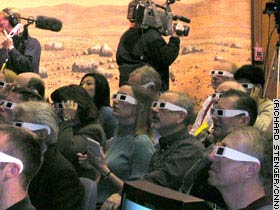
Mars Rover III: The 3-D Adventure

mars audience
This is the most interesting Mars photo so far. Everybody loves 3-D, even jaded space reporters. If you still have your Spy Kids 3-D glasses lying around, you can see what they're looking at in all three dimensions!

November 21, 2003

Brainwashing or Persuasion?

The Washington Post analyzes the concept of brainwashing, particularly as used as a defense in criminal court. One of the sniper suspects says he was brainwashed to kill. This defense has never stood in court, even for Patty Hearst in the 1970's, one of the first popular "brainwashing" victims. The CIA admits that its attempts to brainwash people were failures (theirs are the only records we have of scientific research on the effects of mind control)--they concluded that brainwashing doesn't exist. Nice to know that our government sorted out that little psychological riddle for us.

A lot of psychologists believe that subverting one's identity and behaving according to a captor's commands are logical survival techniques, resulting from fear and confusion. You can control, manipulate, and intimidate a person, but their compliance with your wishes doesn't mean that their identity and self-awareness has been erased. The former president of the American Psychological Association says, "Brains don't get washed, but extreme forms of social influence happen all the time. Coercive persuasion? Sure it exists. But juries find it hard to believe. Nobody wants to believe human nature is so pliable."

So, ADM, come on. Brainwashing, nothing. We all know that you went along with videotaping your sick robot sex romps because part of you, deep down, wanted to do it.

About Science

This page contains an archive of all entries posted to Amy's Robot in the Science category. They are listed from oldest to newest.

Robot-on-the-Spot is the previous category.

Sex is the next category.

Many more can be found on the main index page or by looking through the archives.

Powered by
Movable Type 3.35